


Vivamus is singing well-known works by Allegri, Lotti and Tallis on 10 April. Selling the blazing jewels from the crown of Western European music for Lent is too easy. I’ll leave describing them for the programme notes.
Instead, we need to go to the Max – Maximilian Steinberg, to be precise – and thence, via the absence of multiple sublime presences, to a sublime presence of absence.
Maximilian Steinberg and Passion Week
Maximilian Steinberg, the composer of Passion Week (PW) was born in 1883 in Vilnius, Lithuania, then part of the Russian Empire.
PW draws on Slavonic chant, with associations with multiple geographies. Its evocation of Christ’s being absented from earthly life finds a parallel of sorts in PW’s absence from liturgical or concert performance for more than ninety years. Steinberg went to great lengths to write PW in secret in Petrograd, and then to get it published abroad once he learned sacred music was notionally to be banned in Russia from December 1923, less than a month after he had completed PW.
It appears PW’s premiere did not occur until 2014, directed by the Greek musician and musicologist Dr Alexander Lingas. The absence both of free musical expression and of PW itself are also to be lamented as absences of presence.
Looking back, looking forward
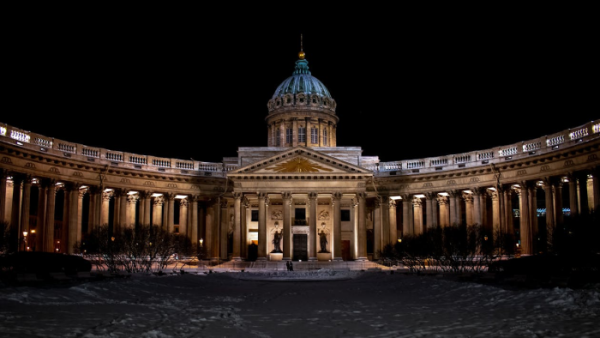
One of my first encounters with Orthodox sacred music was in a service in Kazan Cathedral in St Petersburg (pictured above) in summer 1994. My main memory is the enormous interior of that vast church, and the hitherto invisible singers emerging modestly and clad in black from behind a screen at the end of the service.
I am not religious, but felt the sense of human beings offering themselves up to something greater than themselves had been expressed most eloquently in that service – by the insistence on the sublime presence of their visible absence. One can only hope a similar humility will prevail in matters affecting human relations among Slavic peoples and more broadly.
Post written by Kieran Morgan.
Leave a ReplyCancel reply