


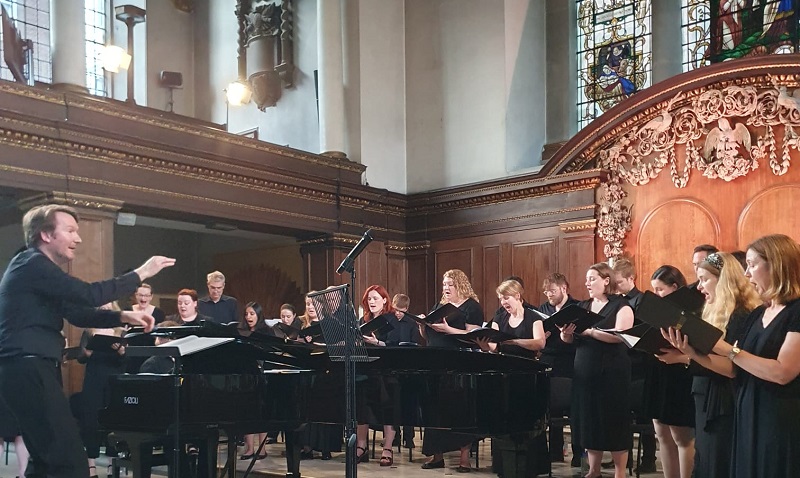
At 8pm on the eve of the longest day of the year, we took our places in St James’s Church, Piccadilly. It was an oasis of calm amid the madness of central London on a hot summer’s evening.
I’d been looking forward to singing in this concert, This Shining Night, since I’d first heard about the concept some months back: a musical journey from dawn to evening, beginning in the daylight and ending as night falls. A programme of American, English, French, Latvian and Scottish music from the 20th and 21st centuries celebrating light in its many guises. It sounded magical.
And it didn’t disappoint.
We opened the concert in daylight with ‘O Radiant Dawn’ by Scottish composer James MacMillan, a majestic piece which we love to sing. And then, with the scene fully set, we transported our audience eastwards for ‘Rivers of Light’, the first of two works by exciting Latvian composer Ēriks Ešenvalds. ‘Rivers of Light’ is an extraordinary musical vision of the northern lights, and was an absolute pleasure to share with our audience – definitely a concert favourite with those I spoke to afterwards. The folk song elements were beautifully sung by soloists Swéta Rana and Kieran Morgan. And the use of a jaw harp, expertly played for us by Eoin O’Connor, added not only to the musical but also the visual interest of the piece.

In a programme woven with contrasts, the northern lights made way for the light of the sun, starting with an organ piece by French composer Messiaen played by our talented musical director, Rufus Frowde. Then came ‘Canticle of the Sun’ by English composer Stephen Dodgson. This was music that had provided a wonderful challenge for us in rehearsal, and with its glory of twists and turns was exhilarating to perform. The choir more than stepped up in the moment and solo lines were wonderfully sung by Max Bamford, Scott Milne, Rachel Wigmore and Sophie Cass. ‘Canticle of the Sun’ was Stephen Dodgson’s last choral composition and we were thrilled to perform it with the CEO of the Stephen Dodgson Charitable Trust in the audience.
Once the excitement of ‘Canticle of the Sun’ had subsided, the mood became gentler with the beauty of ‘Sunset’ by American composer Eric Saari, a gorgeous piece which was a personal favourite. From there the focus shifted to the moon and the stars with our guest pianist, Michael Higgins, treating us to a sparkling performance of Judith Bingham’s ‘Moon Over Westminster’. Then the choir sang Samuel Barber’s ‘Sure on this Shining Night’ (our concert’s namesake!), followed by Cecilia McDowall’s three-movement work ‘Music of the Stars’.
Rather like ‘Canticle of the Sun’, ‘Music of the Stars’ was a piece which had initially divided opinion in the choir, in particular the second movement which sets to music prose written by American astrophysicist and writer Neil deGrasse Tyson. Initially I was at the deeply sceptical end of the spectrum – but I’ve learnt in my two years singing with Vivamus that by the time the concert arrives, any music I was initially unsure about is likely to have won me over. And so it was with ‘Music of the Stars’. All three movements were thrilling to perform, and judging by the enthusiastic applause we received as the final “I can sing!” rang out in St James’s, I think our audience loved hearing it too.

By now you could feel that darkness was falling in Piccadilly, and the natural light in the church was starting to fade. The atmosphere had definitely changed, and after a beautiful rendition of ‘Clair de Lune’ from Michael it felt like a fitting moment for the premiere of ‘Time’, a new piece by our musical director Rufus. ‘Time’ is an incredibly beautiful and poignant piece which was not only moving to perform, but brought some in the audience to tears. It’s always an honour to perform Rufus’ compositions, and performing ‘Time’ was no exception. I hope we and others have the opportunity to share it with audiences again soon.
So, with the last vestiges of light fast disappearing we moved on to Ēriks Ešenvalds’ ‘Stars’, our penultimate piece of the evening. Like ‘Rivers of Light’, ‘Stars’ is accompanied by an unusual instrument, this time in the form of wine glasses tuned with water which provide a glistening accompaniment to the choir’s voices. This is an extraordinarily atmospheric piece which was absolutely wonderful to sing and incorporated a lovely solo moment from Alice Vink. I admit I didn’t trust my multitasking enough to volunteer to be a singer/wine glass player, but full credit to those in the choir who adeptly managed to combine the two skills to fabulous effect.
And as that effect faded we moved into the closing moments of our musical journey in the safe hands of Eric Whitacre’s ‘Sleep’, with all its beautiful dissonance. ‘Sleep’ is a firm Vivamus favourite, and provided the perfect ending to the evening as we closed the concert with the world fading away into silence: “As I surrender unto sleep. As I surrender unto sleep. Sleep. Sleep. Sleep. Sleep…”
We very much hope our audience enjoyed listening to the music of light as much as we enjoyed sharing it with them. It’s always a pleasure.
Post written by Jane Willoughby.
Leave a ReplyCancel reply