


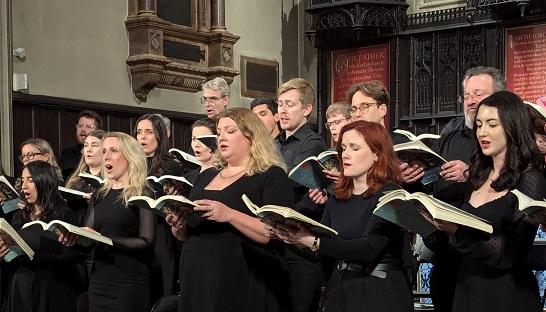
Last Thursday evening, Vivamus performed one of our most atmospheric concerts yet, in the evocative setting of St Dunstan-in-the-West on London’s Fleet Street. In contrast to the hustle and bustle of a warm spring evening in the City outside, with its unusual octagonal interior and warm acoustic, the church provided an atmospheric backdrop for a deeply reflective programme – perfectly timed for the penultimate week of Lent.
As a singer, there is something uniquely powerful about music that spans centuries, each piece a thread in a long tapestry of sacred reflection. We began with works by Antonio Lotti (c. 1667–1740), Gregorio Allegri (1582–1652) and Thomas Tallis (c. 1505–1585) – each familiar from recordings, television broadcasts and classical radio, yet somehow still fresh when performed in person, especially when we physically dispersed throughout the church in order to create a sound that enveloped our audience from all sides.
Lotti’s Crucifixus was particularly charged, its layered dissonances building like a slow, aching prayer. Allegri’s Miserere, with its soaring top notes and haunting simplicity, filled the space with sound. And Tallis’s Lamentations, the earliest piece in our programme, felt timeless, the sorrow in the polyphony lines echoing across the ages.

But it was Maximilian Steinberg’s Passion Week that defined the evening. Introducing the work to our audience felt like letting them in on a secret – its story of suppression and rediscovery as compelling as the music itself.
As Kieran Morgan, a fellow member of Vivamus, explains: “[The work’s] evocation of Christ’s being absented from earthly life finds a parallel of sorts in Passion Week’s absence from full liturgical or concert performance for more than ninety years. Steinberg went to great lengths to write Passion Week in secret in Petrograd, and then to get it published abroad once he learned sacred music was notionally to be banned in Russia from December 1923, less than a month after he had completed Passion Week: his notebook contains the entry, ‘ … there is no hope of hearing Passion Week … new values have not been created, while the old are humiliated.’”
The arc of the piece from sorrow to resurrection was both vocally demanding and linguistically challenging (being in church Slavonic), but it was always emotionally stirring. By the final movement, with its bombastic “Alleluia”, the hope was that, at the end of an intense programme, Steinberg’s music would lift us – and our audience – into something transcendent.
Join us for our next transformative concert.
Post written by Gerard Lee.
Leave a ReplyCancel reply