
St Mary’s Church in Hitchin, Saturday 30 November 2024
There’s no better way to welcome in the winter than the Hitchin Winter Festival, now in its 33rd year. Vivamus is delighted to be joining the programme with a concert featuring some of the region’s finest musicians of all ages.
In the magnificent setting of St Mary’s Church, Hitchin – the largest parish church in Hertfordshire – Vivamus and its fellow performers will perform eight works by named composers interleaved with seven traditional antiphons for Advent.
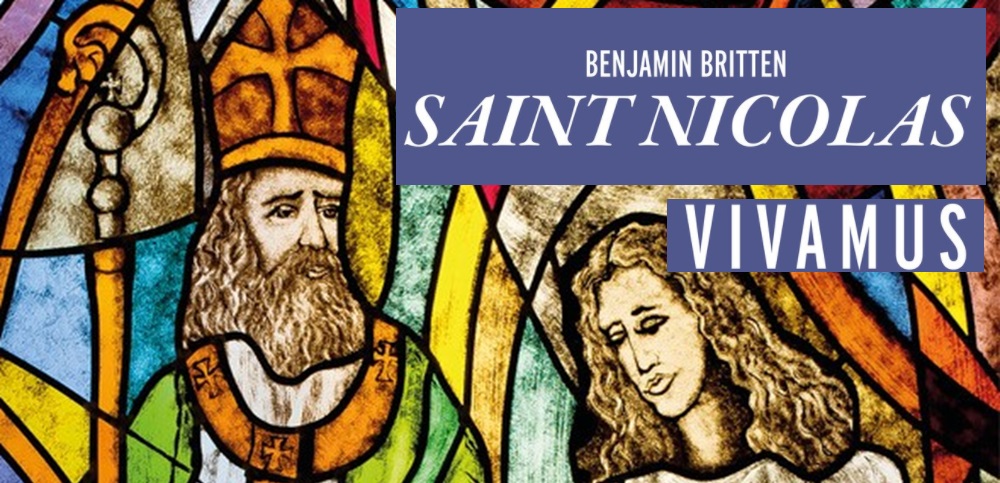
Benjamin Britten’s Saint Nicolas, Britten’s first work for a mixture of professional and amateur musicians, is the headline piece occupying the second half of the programme.
We’ll also be performing seasonal pieces by Andrew Carter, Jonathan Dove, James Macmillan, John Tavener, Hitchin’s very own Iain Farrington, and Vivamus’ Musical Director, Rufus Frowde.
Advent Antiphon 1 (O Sapientia)
An antiphon is a short chant in Christian ritual, sung as a refrain. In certain Christian churches the seven Great Antiphons for the Magnificat begin on 17 December. They can be sung all the way through before and after the Magnificat, the last being sung on 23 December. They are also called the ‘O Antiphons’ because each starts with the letter ‘O’ before calling out a title of Christ. Each can be performed ending ‘Euouae,’ an abbreviation standing for the syllables of the Latin words ‘saeculorum Amen’ (shorthand for ‘World without end. Amen.’ Euouae is used to notate the variable endings of psalm tones in Gregorian chant.
O come, o come, Emmanuel – arr. Andrew Carter (1939–)
Depending on the version performed, the text of this hymn for Advent and Christmas reflects that of some or all of the O Antiphons. Performed today in an arrangement by Andrew Carter, the tune has been quoted by musicians from Respighi to U2.
Advent Antiphon 2 (O Adonai)
O Radiant Dawn – James MacMillan (b. 1959)
O Radiant Dawn is an impassioned antiphon for 21 December, the eleventh of Macmillan’s fourteen Strathclyde Motets, and sets the text of the fifth of the O Antiphons. For some, it acquired a new significance in the early days of the covid-19 pandemic, when humanity hoped for a new dawn. The Stay At Home Choir recorded a performance of it released on 27th June 2020, featuring contributions from 737 singers worldwide.
Advent Antiphon 3 (O Radix Jesse)
Nova, nova – Iain Farrington (b. 1977)
Nova, nova is a setting of a traditional English text from the 15th century, based on St Luke’s Gospel. It tells of the angel Gabriel visiting Mary with news that she will give birth to Jesus. The music is jazz influenced with its bluesy harmonic inflections, rhythmic drive, percussive effects and exuberant energy. In the final section, the mood becomes openly joyful and breaks out into a scene of celebration. Nova, nova was commissioned by the Choir of St John’s College, Cambridge for its Advent Carol Service. It gave the first performance on 26 November 2022, conducted by Andrew Nethsingha.
(Description from the Iain Farrington website.)
Advent Antiphon 4 (O Clavis David)
Adam Lay Ybounden – Rufus Frowde (b. 1978)
Adam lay ybounden is a 15th-century English Christian text of anonymous authorship conveying the medieval idea that Adam was imprisoned in Limbo until the resurrection of Jesus Christ. First performed by Vivamus at the Royal Academy of Arts Carols, St James’s Church, Piccadilly in 2014, Rufus Frowde’s magnificent piece incorporates ison-like drones and a triumphant final thickening of the texture somewhat reminiscent of John Taverner. It is also a nimble and sensitive setting of words once described as reproducing very surely the movements of a human mind.
Advent Antiphon 5 (O Oriens)
Seek Him that maketh the seven stars – Jonathan Dove (b. 1959)
Seek Him that maketh the seven stars and Orion and turneth the shadow of death into the morning. Alleluia, yea, the darkness shineth as the day, the night is light about me. Amen. (Amos 5:8; Psalm 139)
Seek Him was commissioned by the Royal Academy of Arts and first performed at St. James’ Piccadilly – with both of which Vivamus has connections, as noted above – in May 1995. It includes long arching lines and highly syncopated sections, switching between triple and quadruple time before returning to the original tempo in a slow final section in 7/4. Perhaps this is intended to evoke the seven stars of the title.
Advent Antiphon 6 (O Rex Gentium)
A Hymn to the Mother of God – John Tavener (1944–2013)
John Tavener converted to Russian Orthodox Christianity in 1977 and began travelling frequently to Greece, another important centre of Orthodox Christianity. He often referred to his own music as ‘icons in sound,’ drawing upon the Orthodox tradition of utilizing religious images of Jesus, the Virgin Mary and the saints as a portal into the divine. The first of a set of two hymns, A Hymn to the Mother of God is a setting for double choir of a text from the Liturgy of St Basil and was first performed in 1985. Marked ‘With awesome majesty and splendour,’ according to the composer, ‘It speaks of the almost cosmic power attributed to the Mother of God by the Orthodox Church.’ The score is also presciently marked, ‘Owing to the canonic writing, it is not possible to represent the effect of this work on the keyboard.’
Advent Antiphon 7 (O Emmanuel)
Gaudete in Domino semper – Rufus Frowde (b. 1978)
Gaudete in Domino semper, an Introit for the third Sunday of Advent, was premiered by Vivamus at St James’s Church, Spanish Place in December 2016 conducted by the composer and with Vivamus’ Associate Director of Music Richard Hills at the organ console. The piece combines an upbeat refrain repeated mainly in the upper three voices with quotations from ancient chant introduced by the basses and then boldly reintroduced at the end of the piece. It was also recorded from home during lockdown by members of the choir in late 2021.
Saint Nicolas – Benjamin Britten (1913–1976)
Saint Nicolas is a cantata with music by Benjamin Britten on a text by his longtime associate Eric Crozier. Completed in 1948, and hereafter referred to as SNC, it draws on the legends surrounding the life of Saint Nicolas (traditionally 270–343), Bishop of Myra in the present-day Anatalya Province of Türkiye. SNC is scored for mixed choir, tenor soloist, four boy singers, strings, piano duet, organ and percussion. Britten’s first work for a mixture of professional and amateur musicians, SNC also includes two congregational hymns, and received its premiere at the opening concert of the first Aldeburgh Festival in June 1948.
1. Introduction
SNC opens with an introduction in which the mixed choir implores Nicolas to tell the true story of Nicolas, the man, and then undertakes to serve God with simplicity, a recurring notion in the piece as a whole. Harmonic tension, chromatic windings and the independent string accompaniment perhaps combine to evoke a sense of truth endeavouring to emerge, as if through a cloud of incense. Nicolas’ response ends on the word ‘God’ voiced on the note A natural, the main pedal tone for the choral prayer that resumes after Nicolas’ interjection, and the final note of the movement as a whole (rendered high and quietly by a solo violin).
2. The Birth of Nicolas
An abrupt contrast in mood is afforded by the largely joyful and playful second movement, which abounds in tales of miracles from the early life of the saint, ranging from the boy Nicolas climbing into the font to be baptised to water rippling ‘Welcome!’ in the bathtub by his side. The movement is punctuated seven times by the refrain, ‘GOD BE GLORIFIED!’” The first six are marked ‘The boy Nicolas; to be sung by the youngest boy in the choir’ while the seventh is marked ‘The young man Nicolas; Tenor’ and features a semitone clash.
3. Nicolas Devotes Himself to God
The third movement is marked ‘as if in the style of a recitative; simply’ and describes Nicolas’ journey from the tranquil beauty of his late parents’ home to the wider world of men and thereafter to sweet humility, albeit via multiple feelings of heartsickness. The difficulty he experiences in achieving full devotion to God’s will is perhaps expressed through the widespread use of dissonant harmonies and the tonally minor atmosphere of the last three bars even once ‘Love was satisfied.’
4. He Journeys to Palestine
The fourth movement of SNC depicts a sea voyage bringing Nicolas to Palestine. A massive storm drives the sailors from mocking Nicolas to terror. Beautiful passages for the upper voices then lower voices in two or three parts describe the peak of storm and the moment Nicolas kneels to pray with the sailors. A slightly altered version of the melody with which the movement began brings the movement to a close over the figure of the kneeling, weeping Nicolas, while a repeated piano figure over gently pulsing strings conjures an image of small, pitiable man against the enormity of the wind, sea and sky.
5. Nicolas Comes to Myra and is Chosen Bishop
In this movement, Nicolas is appointed Bishop of Myra. The chorus calls upon him to assume various items of ceremonial dress, which, interestingly, Movement 1 has suggested ‘Obscure the simple man within the saint.’ The chorus’ pleas are nonetheless set to some of most earnest and sweetest music imaginable, perhaps most notably in the passage commencing ‘Set the ring upon your hand …’ Halfway through the movement, a fugato sets the words ‘Serve the Faith and spurn his enemies.’ The movement ends with a setting of the hymn known as Old Hundredth for chorus, semi-chorus and audience/congregation, which features in the last verse a repeated accented or marcato figure in the orchestral accompaniment that greatly heightens the emotional intensity and sincerity of the music.
6. Nicolas from Prison
According to the edition from which much of Vivamus is singing today, during the persecution of the martyrs (303–311) Nicolas was imprisoned under the Roman Emperor Diocletian. Movement 6, like Movement 3, is broadly recitative in style, but at a much faster tempo and with the expression marking ‘fast and agitated.’ Not for the first time in the cantata as a whole, Nicolas delivers a clear message of humility and devotion using musical materials arguably less consistent in their emotional stability.
7. Nicolas and the Pickled Boys
Movement 7 sets the legend of the Pickled Boys, in which Nicolas calls three boys back to life who had been killed and pickled by a butcher in time of famine. The opening of the piece, with its slightly macabre march-like feel, images of hunger and long-distance travel down snowy roads, recalls to the author of these notes similar evocations of the vast expanses of Russia: ‘O we have far to go!’ The boys restored, the movement ends with a jollier repetition of the march-like musical idea from the opening.
8. His Piety and Marvellous Works
Movement 8 consists of three sections. Sections 1 and 3 sum up Nicolas’ life and works and describe how his memory lives on ‘In legends that our children and their children’s children treasure still.’ These sections are marked ‘Pleasantly, sweetly.’ Section 2 is a lively exposition of various specific legends and tales, including Nicolas’ striking of Arius, the founder of the Arian heresy, at the First Council of Nicaea in 325. In the premier of SNC, the seven semi-choruses required in this section were sung by four different school choirs.
9. The Death of Nicolas
Movement 9 contains an extended tenor solo in which Nicolas addresses death, the Lord and Christ in turn in words that speak of love, rebirth and acceptance even as the melody expresses the pain of death in highly chromatic musical language. The orchestral introduction preceding, chorus chant of the Nunc dimittis accompanying, and orchestral interlude following the solo all use or draw on the Gregorian ‘fourth tone.’ As with Nicolas’ appointment as bishop, the end of his life and of SNC is marked with a congregational hymn. Once again, sea, storm and sky are evoked, as with Movement 4, and as so notably across Britten’s wider output.
Performers
Vivamus

Vivamus is a small, London-based chamber choir. We enjoy singing a diverse and challenging range of repertoire, from well-known classics to new works by living composers. We rehearse weekly at St Clement Danes, the Central Church of the RAF, and aim to perform at least four times a year at venues in and around central London, including St Martin-in-the-Fields and St James’s Piccadilly. We also organise away weekends to sing in UK cathedrals.
Our Christmas concert will be on Thursday 12 December 2024, at St Clement Danes.
Rufus Frowde, Musical Director

Rufus read music at Oxford University (where he was Conductor of the Oxford University Philharmonia, Organ Scholar of Merton College and a tenor in Schola Cantorum. He performed his Finals Recital as a violinist). He subsequently became Organ Scholar of Worcester Cathedral. In 2003, Rufus took up his post as Organist and Assistant Director of Music at the Chapel Royal, Hampton Court Palace. He combined this with prize-winning postgraduate study in Choral Direction and Church Music at the Royal Academy of Music before embarking on a freelance career as a conductor, organist, accompanist and composer. He joined Vivamus in 2008.
He is a passionate educator and is heavily involved in the work of Hertfordshire Music Service as an orchestral conductor and animateur (most notably as Artistic and Musical Director of the Hertfordshire Schools’ Galas at the Royal Albert Hall) and with the Chorister Outreach Programme at St Albans Cathedral. He also delivers the music curriculum at Samuel Lucas Primary School, Hitchin. Rufus appears as a conductor and organist on the Divine Art, Diversions, Resonus Classics and Signum Classics labels and has broadcast on national television and radio. Contemporary music features highly in Rufus’s diary and he has conducted and played for numerous premieres including works by Judith Weir, Richard Allain, Ben Parry, Anne Dudley, Graham Ross, Sasha Johnson Manning, Richard Sisson and Will Todd. He has given organ recitals at numerous UK cathedrals and at Westminster Abbey. He is also active as a composer. His carol Adam lay ybounden was given its premiere at the Annual Carol Service for the Royal Academy of Arts.
Anna Le Hair, Piano

Anna Le Hair gained an honours degree in music at Edinburgh University and her postgraduate studies were at the Royal College of Music, London. Anna has a busy and varied career as a performer, teacher, accompanist, ABRSM examiner, adjudicator and conductor. Engagements have included recitals, both solo and as chamber musician and accompanist, as well as soloist in several piano concertos, in many venues in London, around Britain and abroad. Anna currently teaches piano and accompanies at St Albans School and also has a thriving private teaching practice at her home in Tring. She is the founder of and runs the successful ‘Piano and more’ concert series at St Peter and St Paul Church in Tring and is a founder member of the Icknield Ensemble. She completed her first international examining tour for ABRSM in summer 2019 to Malaysia. Anna has several upcoming performances, details of which can be found on on the Anna Le Hair website.
Nicholas Shaw, Piano

Nicholas Shaw maintains a varied career as a conductor and keyboard player. As Youth Chorus Master of Opera North, he has oversight of all the vocal activity in the Learning Department and has conducted many shows in Leeds and on tour around the North of England. This season he has been busy preparing children for performances of Britten’s Midsummer Night’s Dream, Mozart’s The Magic Flute, Kurt Weill’s Love Life and will conduct the UK premiere of Judith Weir’s The Secret of the Black Spider in September. Further south he is Organist and Director of Chapel Music at Lincoln’s Inn in London where he conducts the professional choir in activity both in Chapel and throughout the Inn. He has a particular passion for new music and has commissioned fifteen new choral works based on the writings of John Donne, the former Preacher, the most recent of which was nominated for an Ivor Novello award. Nicholas also teaches at St Paul’s Girls’ School and is the Assistant Music Director of the Reading Bach Choir. He trained as the organ scholar of Magdalen College, Oxford and then studied at the Royal Academy of Music as a founding student on the choral conducting course. He was made an Associate of the Royal Academy of Music in 2012 and was nominated an inspirational educator by the Worshipful Company of Educators in 2023.
Graham Neal, Tenor

Graham Neal is a graduate of the University of Surrey, the Knack opera course at the English National Opera, and Trinity College of Music.
On the operatic stage, Graham has performed at The Royal Opera House, The English National Opera, Festival d’Aix-en-Provence, l’Opera Comique, Iford International Arts Festival, and Grange Park Opera.
Graham is an accomplished ensemble singer, appearing frequently in concert, on television, and on recordings. He performs with The English Concert, The King’s Consort, the BBC Singers, Philharmonia Voices, the Academy of Ancient Music, the Armonico Consort, the Odyssean Ensemble, Sonoro, Cappella Nova and The Monteverdi Choir, with whom he sang at the Coronation of Their Majesties The King and Queen. He is also a member of the choir of the London Oratory Church.
Joshua Gearing, Lead Percussionist

Joshua Gearing began learning the piano at five years old, followed by the cello, and then percussion aged seven, after watching a local youth orchestra play and being captivated by the range of sounds coming from the back of the room. He takes every opportunity to play, whether it be a small jazz combo in a club or accompanying a choir. He was a percussionist with the National Youth Orchestra for three years and a percussion finalist on BBC Young Musician of the Year 2022. Joshua’s musical activities have since included working as a freelance percussionist, drummer or orchestral keyboardist with various professional and amateur groups; as an accompanist; as a director of music; as a music teacher and assistant tutor; and as a composer and arranger. He has also been learning the organ in recent years.
North Herts and Stevenage Youth Orchestra
North Herts and Stevenage Youth Orchestra are a full symphony orchestra for senior players from across the North Herts and Stevenage region. The orchestra enjoy playing a varied repertoire from orchestral classics to film music, and everything in between. Each year the group perform at the Priory Picnic, as part of the Hitchin Festival, as well as performances in the wider community across the North Herts and Stevenage Region. For more information about their upcoming concerts, please follow @HMSNorthHerts on Facebook.
Violins
- Imogen Rose
- Alfie Fitzgerald
- Orin Salmon
- Tegan Fitzgerald
- Josef Frowde
- Annabelle Brown
- Isabelle Wong
- Aaron Powell
Cellos
- Tristan Moss
- Florence Whitehead
- Susannah Battarbee
- Eleanor Davis
The Paean Ensemble and Youth Orchestra
The Paean Ensemble is a professional instrumental group founded by Vivamus’ Musical Director, Rufus Frowde.
Violin 1
- Alison Wyatt
- Imogen Rose
- Orin Salmon
- Kishan Bhatia
- Alfie Fitzgerald
Violin 2
- Ammal Bhatia
- Annabelle Brown
- Isabelle Wong
- Tegan Fitzgerald
- Phoebe Lally
- Josef Frowde
Viola
- Emma Abrams
- Aaron Powell
- Patrick Abrams
Cello
- Anna Menzies
- Florence Whitehead
- Tristan Moss
- Susannah Battersby
- Eleanor Davis
Double bass
- Manuel Dell’olgio
Organ
- Tom Winpenny
Piano duet
- Anna Le Hair
- Nicholas Shaw
Percussion
- Daniel Basford
- Josh Gearing
The Choir of Samuel Lucas JMI School
Vivamus is particularly delighted to perform alongside younger musicians, since we count among our charitable objectives to educate the public by promoting, fostering and encouraging the knowledge, understanding and appreciation of the art of music in all its forms; and to educate and train young persons in the performance of music and to promote the recognition and encouragement of exceptional merit.
Support Vivamus
If you are interested in supporting the choir or any of our future concerts, please get in touch.