


The cobwebs of winter were finally blown away as Richard Hills, Vivamus’ Accompanist and Associate Director of Music, kicked off our spring concert last Friday night with a dazzlingly fizzy rendition of Widor’s Toccata for organ. Once voted the nation’s favourite piece of wedding music by listeners of Classic FM (and still the cause of occasional night sweats after a friend asked me to play it to usher in her married life), the Toccata’s sparkling arpeggios and booming pedal melody felt like they were heralding a new chapter of the year for choir and audience alike.
The theme of passing time resonated for me throughout the concert. Rehearsals began in the cold, dark evenings of January when we first started learning these pieces under the expert tuition of our Musical Director, Rufus Frowde. As the days became longer, our familiarity with the French repertoire grew. By concert day, and just in time for the arrival of spring, we felt a collective confidence and ease with the music, a testament to the dedication of both us as singers and Rufus as our director.
The first choral performance of the evening was of Gabriel Fauré’s Cantique de Jean Racine. Composed by Fauré when he was just 19 years old, the piece is a staple of the choral repertoire, familiar to some of us from our experiences in previous choirs. However, Rufus presented us with a new challenge: singing the piece from memory, facing our audience directly, hands by our sides with no sheet music to distract either singers or audience. This simple approach stripped the piece bare for us as performers, revealing its beauty in a new light – a remarkable feat for a piece so well-known (even if memorising the French text proved more difficult for some of us than others!).
From an old favourite to a new one for many of us, the Cantique was followed by Pierre Villette’s lesser known setting of the Panis Angelicus. The deceptive simplicity of the opening of the piece blossoms into harmonic complexity and dissonance, before returning to the simplicity of the opening but ending on an ambiguous, hummed chord. A friend remarked to me that it was her highlight of the evening, and it served as a reminder of the privilege we have in Vivamus, which hopefully extends to our audiences: the opportunity to make new musical discoveries with every performance.


Next on the programme was another Fauré composition, his Pavane in F-sharp minor. One of my earliest memories of classical music is the BBC’s use of the piece as the theme for its coverage of the 1998 World Cup (though the sporting dimension of my interest was quickly superseded by its interpolation in pop group S Club 7’s classic single Natural a few years later…). However, for me, the performance at our concert was like hearing the Pavane for the very first time. Performed by Richard Hills on piano and our guest cellist for the evening, Yuki Ito, it was stunning and constituted my own highlight of the evening. For someone more familiar with the bombastic arrangement of the piece for orchestra and choir, the simplicity of the piano and cello arrangement was breathtaking. Both performers delivered a performance of controlled yet expressive lyricism, revealing a depth of melancholy and yearning in the piece that had previously escaped me.
We then arrived at the centrepiece of our programme: Duruflé’s Requiem. As with any setting of the requiem mass, the subject matter lends itself to drama and emotion, inevitably triggering thoughts of our own mortality in some future time. John Holland-Avery’s powerful baritone solo resonated deeply, and cellist Yuko Ito again demonstrated the expressive potential of his instrument, beautifully complementing the soprano melody of the Pie Jesus. The Requiem, new to me yet reminiscent of Fauré’s well-known setting and the Gregorian plainchant of my Catholic upbringing, embodied the passage of time in my musical journey so far – a confluence of past memories and fresh experiences.

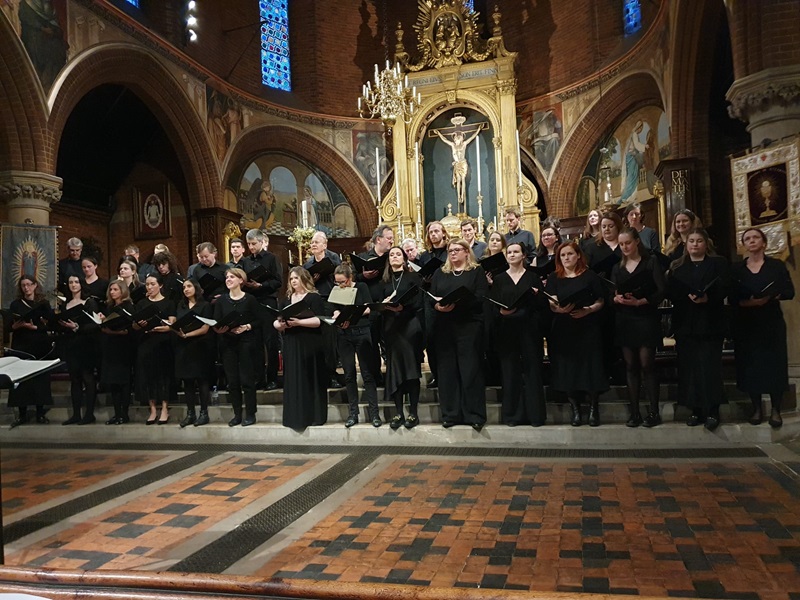
The tight, cohesive programme in the beautiful, atmospheric setting of St Mary’s Bourne Street made for one of my favourite concerts during my 14 years as a member of the choir. It was a joy to discover both new pieces and new dimensions to old pieces, a testament to the continuous learning experience that Vivamus provides under Rufus’ unfailingly enthusiastic leadership. It is a joy we share not only amongst ourselves but also, hopefully, with every member of our audience.
See Vivamus’ upcoming performances.
Post written by Gerard Lee.
Leave a ReplyCancel reply