


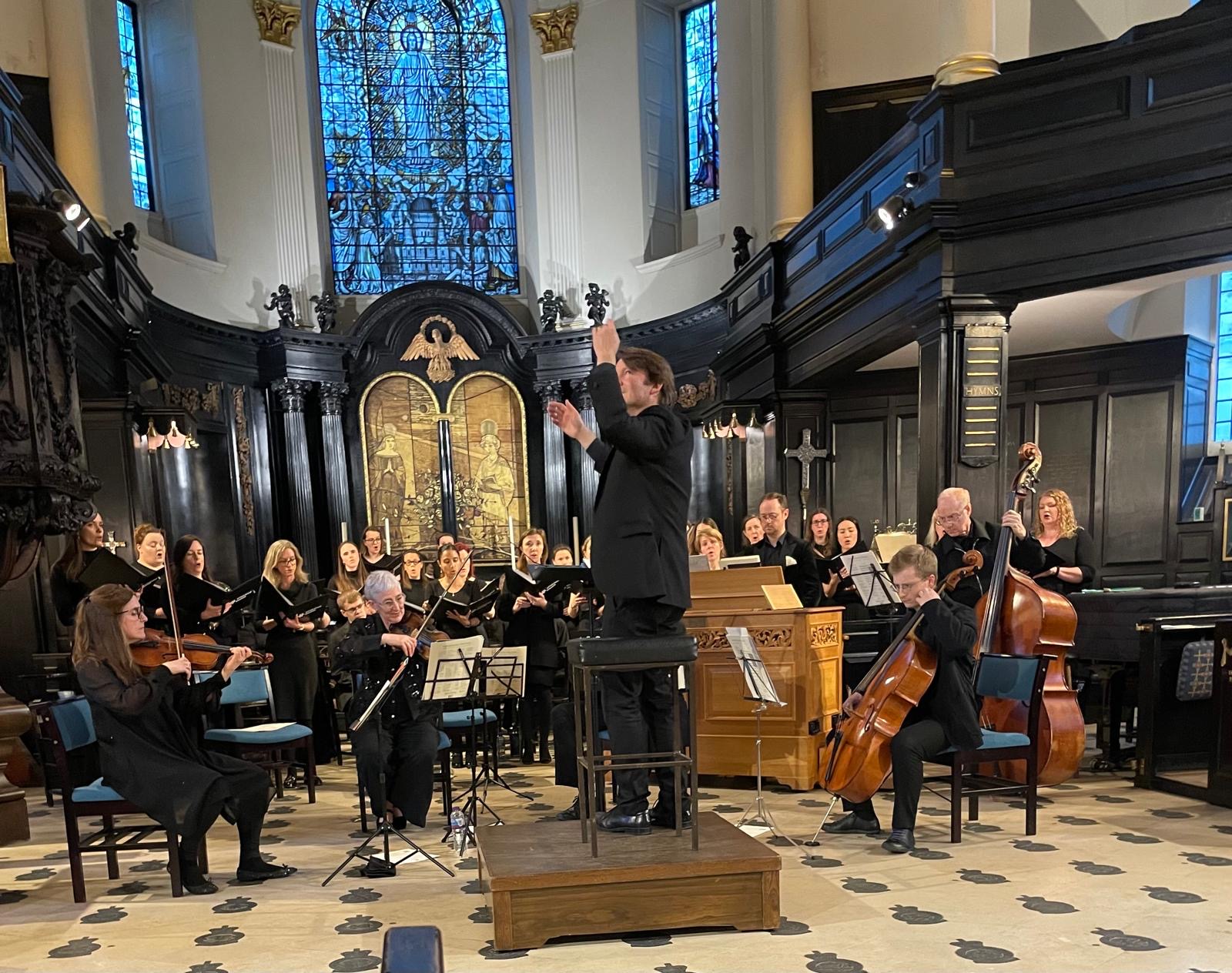
A post-concert reflection
The Baroque style used elements of contrast, movement, exuberant detail, grandeur and surprise to achieve a sense of awe. I think Vivamus’ recent concert Gloria assembled these Baroque elements, and here’s why.
The concert started with the radiant opening movement of Handel’s Ode for the Birthday of Queen Anne, ‘Eternal Source of Light Divine’ (ESLD). ESLD was performed at a pitch that allowed both sopranos and altos to take part. As someone who has benefited a great deal from inclusive approaches to music-making – notably his – I was very grateful to Vivamus’ Music Director Rufus Frowde for this supportive adjustment, and I wasn’t even singing in it. Team Soprano and Alto seized the opportunity and produced a wondrous sound. Queen Anne reportedly gave Handel a pension for life in thanks for her birthday ode. I can’t endow Vivamus with a pension, but I can pass on my Bach-loving friend’s comment that ESLD was his favourite item in the first half. Grandeur indeed!
Next up was Purcell’s Rejoice in the Lord alway, long established as one of the most beloved English anthems of the late seventeenth century. However, I was surprised many times in the course of rehearsing and performing the piece. A Baroque concert in which the Purcell piece did not have the most chromatic scales? A Purcell piece in which one of the chromatic moments was in a solo I had unexpectedly been allocated?? A Purcell piece with extended symphonic passages, one of which was just before my solo, meaning I had to count properly like an instrumentalist??? Nonetheless, the performance of the choir, orchestra and all my fellow soloists left me rejoicing, alway.
I’m going to allow myself a second invocation of grandeur as I contemplate the magnificent rendition of Handel’s Oboe Concerto No. 3 in G minor by the Brandenburg Sinfonia. Choir colleagues will acknowledge that, whatever my precise level of technical skill, music really gets me in the feels. I’m normally most drawn to emotionally fraught choral stuff – think anything from our concert Lament and Light or Time by Rufus Frowde. However, such is the stately magnificence of this compact concerto, its opening movement somehow caught between severe yet courtly dance rhythms and soaring phrases for oboe, that I am now pretty much addicted to it. If the Brandenburg Sinfonia and distinguished oboe soloist Richard Simpson enjoyed Vivamus’ contribution, I can only say ‘Right back atcha.’
Contrast runs through Bach’s motet Jesu, meine Freude. As I wrote in the programme, the piece interweaves stanzas of chorale text with passages from Paul’s Letter to the Romans. I felt this really came across in performance, my personal highlight being the contrast between ‘Weg mit allen Schätzen’ (chorale text) and ‘So aber Christus in euch ist’ (Romans). The punctuation-heavy chorale text was heavily accented and all but spat out by the whole choir, while the scripture was sung by nine singers in three parts, imparting a light, dance-like charm to music sensitively accompanied by Richard Hills (Chamber Organ).
Monteverdi’s Beatus vir is one of the most exuberant sacred works of the early Baroque. I know the piece reasonably well, having first performed it in Finland in 1997 (who knew?) However, to take the exuberant detail to another level, how about one tenor soloist saying to another in rehearsal, ‘Right, this is where I get to dance with you!’ I would have paid to watch that, but instead got a free pass to listen to the musical version and have to say the duet at ‘The strength of his soul will be exalted with honour’ has rarely been expressed so freely, colourfully or tastefully.
Vivaldi’s Gloria in D major is his best-known liturgical composition. Its twelve movements form a sequence of sharply characterised scenes, while this term could apply to many of the other works in this concert, I am choosing the Vivaldi to represent movement. The performance included a number of wonderful soli and ensemble performances. I never like singling singers out – and could talk at length about the embarrassment of vocal riches – but I particularly enjoyed the energetic dotted rhythms of ‘Domini Fili unigenite’ and the careful pacing of ‘Domine Deus, Rex coelestis’ (among others!)
I must, however, be allowed one final element of surprise. What I most enjoyed about the concert was the way the members of Vivamus and the Brandenburg Sinfonia pulled together to make the concert such a musical and social success. To ‘glory’ in some musical and logistical successes, it was a joy for the singers to be supported by the greater weight of sound provided by a professional Baroque band as opposed to just the piano we use in rehearsals; and I very much hope audience members and eligible instrumentalists alike enjoyed the skilfully organised refreshments. Henry Purcell, who liked a drink and a night at the theatre, would no doubt have approved.
Post written by Kieran Morgan